Written by Nick Schonfeld
Smoke Phiri looks like an archetypal henchman. His massive frame towers over his family of nine children. At 50 years old, he seems to have lost none of his strength or virility. As he talks, he gestures confidently with large calloused hands. Smoke is, frankly, a little intimidating. And that’s not surprising, because for two decades, Smoke was a prolific poacher.
Photographer Julia Gunther and I met Smoke while on an IFAW/COMACO project visit to Chikomeni and Mwasemphangwe chiefdoms in eastern Zambia, which form part of the Malawi-Zambia Trans frontier Conservation Area (TFCA). Mostly aimed at female farmers and poachers, the project is a new partnership, started in 2021, between IFAW and COMACO, and is funded by the German Agency for International Cooperation (GIZ).
As is often the case with multi-partner projects, the name is a bit of a mouthful: “Enhancing Climate Resilience and Cross Border Collaborations in Kasungu/Lukusuzi Trans-frontier Conservation Area (TFCA)”. But its goals are both ambitious and very necessary.
Populated mainly by small-scale, low-income farmers, Chikomeni and Mwasemphangwe chiefdoms are squeezed in between Lukusuzi National Park on the left and Kasungu National Park in Malawi on the right. The two chiefdoms are part of a wildlife corridor between the unfenced parks across which buffalo, hyenas, elephants and countless other species travel up and down throughout the year.
Chronic food insecurity, driven by worsening climate change and the absence of a market for farmers to sell their crops, has forced many into poaching or illegal mining. Those who choose not to, struggle to feed their families for large parts of the year. Add to that the fact that most nights wild animals wander through the farms on their way to or from Kasungu or Lukusuzi, and that farms offer an irresistible supply of food for wildlife, and you have all the ingredients for a classic human-wildlife conflict that makes it very difficult for communities to live in harmony with nature.
Every farm we visited had a corral made of sturdy logs and branches where villagers kept their cattle during the night. Goats were housed on raised platforms and in some places, harvested crops were stored off the ground on drying racks. If left unprotected, jackals or hyenas would cause havoc.
It’s no surprise that the TFCA was a prime hunting ground for poachers like Smoke, who told me he used to kill one or two elephants a week, as well as buffalos, kudu and warthogs. He would sell the ivory as quickly as he could. The bush meat would be eaten or sold at local markets. But that was almost twenty years ago. Smoke stopped poaching in 2003. The reason Smoke stopped is why we are here talking with him in front of his red brick house, surrounded by the fields of sunflowers, soya beans and groundnuts he now grows.
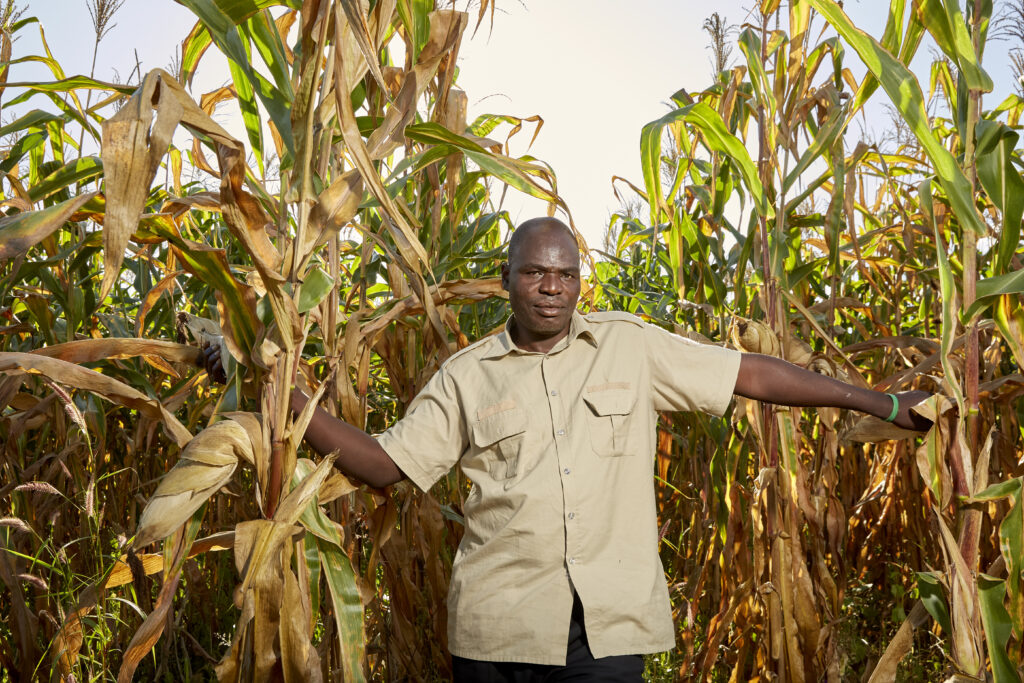
Former poacher Smoke Phiri stands in his maize field in Mwase Mphangwe, Zambia. Photo: Julia Gunther / © IFAW
When I talked to Smoke, and to the other farmers and former poachers we spent time with, they all said the same thing. For people to change, they need a viable alternative. Telling someone to stop poaching when it’s their only source of income, does not work. Lecturing farmers on their destructive farming practices if you don’t show them how to do things differently, does not work. And I can tell you, that after travelling through this remote part of Zambia, where there are precious few markets, where roads are impassable during the rainy season, and where most people run out of food months before they can harvest their next crop, it really is that simple.
This is why COMACO’s approach has been so incredibly effective. If farmers don’t know how to work their land in ways that increases the fertility of the soil, then show them how. If farmers cannot sell their crops because of a lack of access to markets, then create that market.
COMACO retrained Smoke to become a farmer; something he had no experience in – he’d been a poacher since the age of 13. It worked. After being taught new livelihood skills including vegetable gardening, beekeeping, carpentry, poultry and conservation farming, Smoke traded in his .375 rifle and shotgun for a hoe and a few bags of seed, and returned to his home village to start planting. He had undergone a remarkable transformation: from a destructive force to a steward of this important landscape.
Although Smoke is perhaps one of the more dramatic examples of transformation, COMACO doesn’t just focus on poachers. In fact, most of the people they’ve worked with for the past 19 years are traditional farmers who they’ve retrained in smart agricultural techniques; methods, which improve both crop yields and the environment without the use of chemicals or fertilisers.
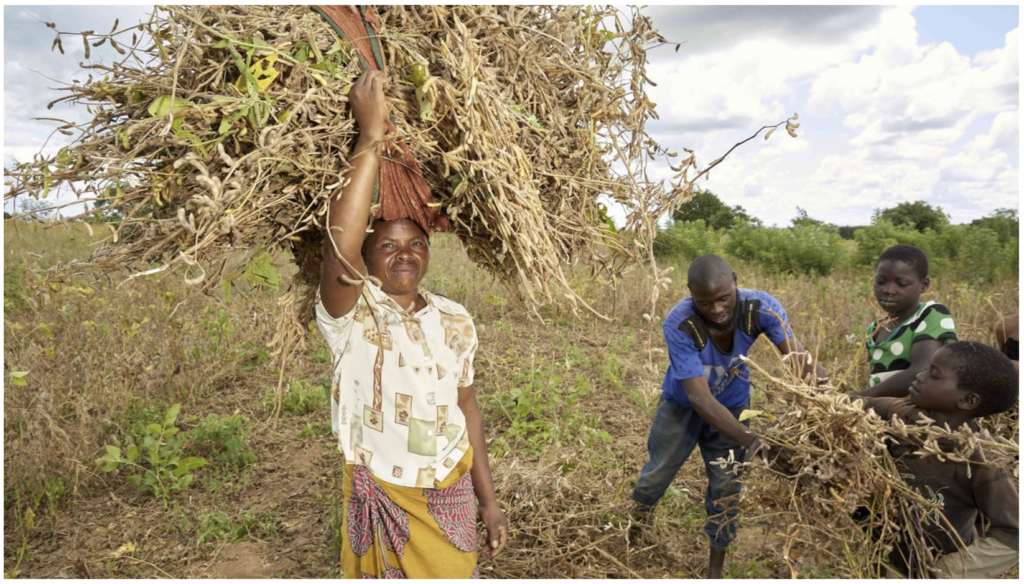
Carrying a pile of harvested soya beans on her head, Grace Mtonga returns to her family village in Chikomeni, Zambia. Photo: Julia Gunther / © IFAW
Everywhere we went, the farmers were keen to tell me what they had learnt. How to till the land as little as possible by using a ripper instead of building ridges, how to use organic material such as leaves or branches as fertiliser, how to plant nitrogen-fixing trees like Gliricidia sepium, and that keeping groundnuts (peanuts) in their shells is a great way to avoid the spread of aflatoxin- a poisonous fungus that if consumed can lead to serious illness or death. These were simple and affordable solutions that helped increase the quality and quantity of the crops they could grow.
After COMACO buys Smoke’s crops at an above the market price, they ship them to their massive factory in Lundazi, the capital of Lundazi district, along with the harvests of thousands of other farmers. On a tour of the plant, we saw warehouses filled with thousands of tons of rice, groundnuts, maize, soya and beans.
There’s a quality control laboratory and a department that develops new products. At one of several milling stations, we met workers who were rushing to finish a 300-ton order of maize and soya porridge mix for Mary’s Meals, an international non-governmental organisation that runs school feeding programs. With 150 tons per month, COMACO is now Zambia’s largest producer of peanut butter. Dozens of COMACO’s It’s Wild! products line the shelves of supermarkets across Zambia. The scale of it all is impressive.
The positive impact of all these transformations is immediately clear. Thanks to projects like this one, small-scale farmers can earn a living, growing nutritious, chemical-free, high-value crops that provide them with income and food security, while learning how to help care for the land and environment they use.
The project, of course, has its challenges. The catchment area is enormous and many of the farmers live in remote villages. And, as with any community project, you never get one hundred percent of people to fully commit. But when you look at everything that this project has solved, any remaining issues seem trivial. The benefits are obvious to most. I think that is because many participating farmers share their experiences with others and help recruit new candidates. Many of COMACO’s fieldworkers are farmers themselves, a key element in building the trust you need when implementing a project of this kind.
Smoke is chair of the Transformed Poachers Association and travels to Lundazi prison to coach incarcerated poachers. The other two former poachers we spoke to, Ronald Mwale and Edison Mphande Phiri (he is not related to Smoke) seemed to be extremely happy to have stopped. Not only do they make more money as farmers, but growing crops is also a lot safer. On the last poaching trip he ever organised, Ronald and four fellow hunters ran into a ranger patrol. During the ensuing firefight, all four of his companions were killed.
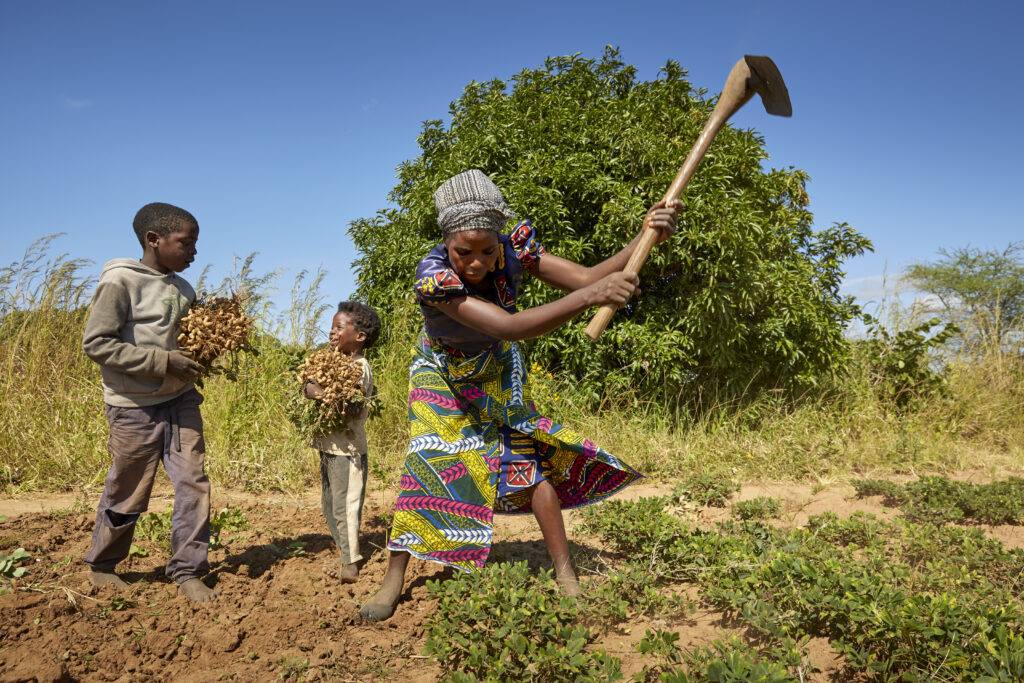
Elita Mwale and her family harvest peanuts on their farm in Chikomeni, Zambia. Photo: Julia Gunther / © IFAW
Elita Mwale, a female farmer with seven children, proudly showed us her new house, her ripper, her two oxen, her ox cart and the shop she was building on land she had bought – all paid for with the money she made by selling her crops to COMACO.
Last year, in 2021, the start of the rains was delayed. Fainess Mgulude could not harvest her crops until later in the season. In previous years, a delayed harvest would have been catastrophic for Fainess, a widow with five children. But since she started using the methods she learnt from COMACO, she has not run out of food once. The delay in rains no longer impacts her as she has enough to last her through the entire year.
There are plenty more examples. You can see the change everywhere in the TFCA. From elephants to sunflowers, from rammed earth to iron sheets, from ridges to ripping, from hunger to surplus, from outlaw to advocate.
But I write about Smoke, Ronald, Edison, Fainess and Elita not for effect or emphasis. I write about them because they deserve to be recognised for the transformation they went through. Because for them, and the many thousands of others whose existence depends entirely on their relationship with the natural world around them, it’s a game-changer.
]]>To address this growing problem, COMACO, in partnership with ZAWA (the Zambian Wildlife Authority) has established regional troops of volunteer “Chiliblasters,” who operate in the model of a volunteer fire department, except instead of fighting fires they fight crop disturbance by elephants.[/vc_column_text][blockquote style=”left_border” font_size=”24px” color=”#9e9e9e”]“What I like about blasting is I’m on the side of the good people, the law-abiding citizens. It’s what I’ve been yearning for all along,” said Maxon Ninconde, an ex-poacher from Chifunda.[/blockquote][vc_row_inner][vc_column_inner width=”2/3″][vc_single_image image=”8313″ img_size=”full” add_caption=”yes”][/vc_column_inner][vc_column_inner width=”1/3″][vc_column_text]Using a humane technique designed to scare away elephants with an unpleasant sensation, but cause no lasting harm, chiliblasting could be equated to the Western American use of bear spray. “Blasters,” as they’re commonly known, use muzzle-loaded guns to shoot small paper packages of finely ground chili pepper into the air, which explode and irritate the elephant’s breathing. Startled by the noise of the gun, and scared by the burning sensation in their lungs, the elephants flee from the blasting site and will stay clear of that location for several weeks.[/vc_column_text][/vc_column_inner][/vc_row_inner][/vc_column][/vc_row][vc_row css=”.vc_custom_1454241148818{padding-top: 10px !important;}”][vc_column width=”1/2″][vc_column_text]Of all the techniques used to deter elephants from robbing fields—solar electric fences, fires, noise—chiliblasting has proven to be most effective. And with the increased incidents of disturbance, there is a near constant need. Often blasters will walk a total of seven kilometers and respond to up to three different calls for help in one evening session.
Chiliblasters are reformed poachers, eager to use their skills in wildlife tracking and marksmanship to serve their community. At dawn each morning and again just before dusk, when crop disturbance is most common, they meet at the nearby ZAWA camp to prepare their muzzle-loaded guns.[/vc_column_text][/vc_column][vc_column width=”1/2″][vc_column_text]Using the same rifles they surrendered when taking the COMACO pledge for conservation, instead of bullets, this time blasters fill the muzzles with chili, gun powder, and a paper stuffing to hold the concoction in place while they navigate rough terrain.
The mechanics of chiliblasting resembles poaching in many ways. It involves stalking the elephants within 30 meters to get a clear shot, reading the signs and behavior of the animal to avoid being charged, and executing a clean shot. In most cases, blasters are accompanied by an armed ZAWA officer, sometimes the same individual who arrested them when they were poachers, who stands guard and could exert force if anything went wrong. But so far, the blasters have never had a serious accident.[/vc_column_text][/vc_column][/vc_row][vc_row][vc_column][vc_single_image image=”8318″ img_size=”full” add_caption=”yes” alignment=”center”][/vc_column][/vc_row][vc_row css=”.vc_custom_1454241148818{padding-top: 10px !important;}”][vc_column][vc_column_text]
Being a blaster is a tremendous amount of work for no pay. It pulls farmers away from their own fields to attend to the needs of their neighbors, and often requires walking dozens of kilometers in one day, sometimes in the pouring rain, to reach remote fields. But blasting also offers ex-poachers something more than money, it gives them a way to redeem themselves in the eyes of their communities.
“What I like about blasting is I’m on the side of the good people, the law-abiding citizens. It’s what I’ve been yearning for all along,” said Maxon Ninconde, an ex-poacher from Chifunda.[/vc_column_text][/vc_column][/vc_row][vc_row css=”.vc_custom_1454241148818{padding-top: 10px !important;}”][vc_column width=”1/2″][vc_single_image image=”8339″ img_size=”full”][/vc_column][vc_column width=”1/2″][vc_single_image image=”8340″ img_size=”full”][/vc_column][/vc_row][vc_row css=”.vc_custom_1454241148818{padding-top: 10px !important;}”][vc_column width=”1/2″][vc_single_image image=”8330″ img_size=”full” add_caption=”yes”][/vc_column][vc_column width=”1/2″][vc_column_text]ZAWA park ranger, Winard Sengeleti, of the North Luangwa Valley region credits chiliblasting for the big improvement in human wildlife conflict in his region.
“The chiliblasting is proving to be quite good, it ensures that the fields are protected. We really appreciate the effort. We don’t have a massive amount of officers to share our role, so we have to bring in partners like COMACO,” he said.[/vc_column_text][/vc_column][/vc_row][vc_row css=”.vc_custom_1454241148818{padding-top: 10px !important;}”][vc_column width=”1/2″][blockquote]“We are the people who reduce human wildlife conflict. Because of our efforts, there are lower numbers of crop damage. That’s how we’ve managed to become food secure in this area. Without chiliblasting I don’t know what would happen.” [/blockquote][/vc_column][vc_column width=”1/2″][vc_column_text]Although blasters are not paid, COMACO organizes trainings and provides cover-all uniforms and rubber boots to protect them from sharp grasses and snake bites. In the short term, blasters hope they can raise enough funds for headlamps and rain jackets, to protect them during the rainy season. And in the long term they hope that one day local government will see the importance of the work they’re doing and pay them for it.
“We are the people who reduce human wildlife conflict,” said David Aunda, a blaster in Chifunda. “Because of our efforts, there are lower numbers of crop damage. That’s how we’ve managed to become food secure in this area. Without chiliblasting I don’t know what would happen.”[/vc_column_text][/vc_column][/vc_row][vc_row][vc_column][vc_single_image image=”8329″ img_size=”full” add_caption=”yes”][/vc_column][/vc_row]
]]>