Lusaka, Zambia/Africa – The Community Markets for Conservation (COMACO) has commended government for rallying the private sector in its strategy to address climate change issues at this year’s United Nations Conference of Parties (COP27) in Egypt.
COMACO Chief Executive Officer (CEO), Dr Dale Lewis, says Zambia’s multisectoral approach to deal with climate change will help the country benefit a wealth of solutions from both the government and the private sector.
Dr Lewis says this will help Zambia not only stand out among the other African countries but also help in transforming small-scale farmers’ livelihoods at the grassroots.
“The scale and mix of humanity to deal with the global climate threats is overwhelming. The Ministry of Green Economy has done a great job in leading the Zambian delegation to engage in key negotiations that will offer long term solutions for Zambia. It is clear, lots of investment to decarbonize Africa, restore forests, and create sustainable farming systems is coming to the continent,” Dr Dale Lewis said.
COMACO is currently at the COP27 as part of the Zambia Delegation representatives where the company is this Saturday, 12th November, expected to give a presentation titled “Farmers, Carbon Markets, and A Model Scaling for Climate Solutions.”
Based on the key themes of COP27, among them agriculture, COMACO is promoting the adoption of farming practices that include creating value from their crop through the production of It’s Wild! products, keeping farmers sedentary so they do not have to clear forests, and helping reduce deforestation that is contributing to revenue benefits for the same communities from carbon sales.
COMACO, is a social enterprise that works with more than 230,000 small scale farmers in Zambia promoting agroforestry through the adoption of Gliricidia sepium, a fast growing, nitrogen-fixing tree that allows farmers to grow crops free from chemical fertiliser while replenishing soil health.
COMACO has since planned to plant 100 million trees for the 2022/2023 season as part of its nature-based solutions for climate change.
Last year in Glasgow Scotland, at the COP26, countries made bold collective commitments to curb emissions, halt, and reverse forest loss, and align the finance sector with net-zero by 2050. This was in recognition of the importance of nature for both reducing emissions and building resilience to the impacts of climate change.
For more information, contact
George Sichinga – Communications Manager, COMACO
Email: gsichinga@staging.itswild.org
Cell: +260966494292
]]>In a few days, #COP27 in Egypt will bring Heads of State and thousands of people together to decide the future of #ClimateAction. Zambia is the Chair of the Africa Group of Negotiators for COP27 and COMACO will be presenting a session titled “Farmers, Carbon Markets, and A Model Scaling for Climate Solutions” to lead the way in catalysing positive change for all key stakeholders. #COMACO@COP27https://youtu.be/Wnc7bYYUi3M
]]>Most did not believe that a company built and led from a foundation of poor, under-skilled farmers could possibly achieve a national food brand, much less turn back the tide of wildlife poaching and deforestation. That vision was nineteen years ago. The place was Zambia’s Luangwa Valley.
Today, most are believing and seeing how the brand It’s Wild! is harnessing the collective energy of over 230,000 small-scale farmers to restore soils and vitalize crops. Important soil nutrients that commercial fertilizers can’t provide without high costs are boosting yields and adding extra nutrition to our diet. They are also discovering how these farmers, scattered across landscapes where forests remain and often not far from wildlife, have become true conservation farmers, demonstrating that farming and conservation succeed better when they support each other. In the marketplace, consumers are choosing It’s Wild! for its quality, and are often willing to pay more once they learn how the brand helps farmers and nature thrive together.
Farmers too are discovering that they have a future in the marketplace by growing this story. In the past, farmers were tied to companies whose primary motive was simply profits for themselves. There was no story for conservation. COMACO has changed that by offering farmers far more profits when tied to environmental protection and has gone the extra step by inviting farmers a seat on its board to grow the business as true partners. To fill this seat, farmer cooperatives that COMACO helped to form, totalling 103 across 86 chiefdoms, established a federation to give a voice for their journey with COMACO and selected a chairperson to represent them.
As a business model COMACO continues to evolve. With each new step COMACO takes, we learn with growing
confidence and excitement that the path we are on is the right one. Farmers feel it too. They’ve seen their income rise, crops less threatened from climate and pests, and new market opportunities emerge from their effort to conserve.
If we are going to save our planet, small-scale farmers who till much of our available land area must be part of the solution. COMACO is giving us a solution that has the momentum to build a movement around a brand that started with poor farmers who now stand tall with the knowledge and the markets that conservation can bring. To learn more about COMACO visit www.staging.itswild.org.
]]>Written by Nick Schonfeld
Smoke Phiri looks like an archetypal henchman. His massive frame towers over his family of nine children. At 50 years old, he seems to have lost none of his strength or virility. As he talks, he gestures confidently with large calloused hands. Smoke is, frankly, a little intimidating. And that’s not surprising, because for two decades, Smoke was a prolific poacher.
Photographer Julia Gunther and I met Smoke while on an IFAW/COMACO project visit to Chikomeni and Mwasemphangwe chiefdoms in eastern Zambia, which form part of the Malawi-Zambia Trans frontier Conservation Area (TFCA). Mostly aimed at female farmers and poachers, the project is a new partnership, started in 2021, between IFAW and COMACO, and is funded by the German Agency for International Cooperation (GIZ).
As is often the case with multi-partner projects, the name is a bit of a mouthful: “Enhancing Climate Resilience and Cross Border Collaborations in Kasungu/Lukusuzi Trans-frontier Conservation Area (TFCA)”. But its goals are both ambitious and very necessary.
Populated mainly by small-scale, low-income farmers, Chikomeni and Mwasemphangwe chiefdoms are squeezed in between Lukusuzi National Park on the left and Kasungu National Park in Malawi on the right. The two chiefdoms are part of a wildlife corridor between the unfenced parks across which buffalo, hyenas, elephants and countless other species travel up and down throughout the year.
Chronic food insecurity, driven by worsening climate change and the absence of a market for farmers to sell their crops, has forced many into poaching or illegal mining. Those who choose not to, struggle to feed their families for large parts of the year. Add to that the fact that most nights wild animals wander through the farms on their way to or from Kasungu or Lukusuzi, and that farms offer an irresistible supply of food for wildlife, and you have all the ingredients for a classic human-wildlife conflict that makes it very difficult for communities to live in harmony with nature.
Every farm we visited had a corral made of sturdy logs and branches where villagers kept their cattle during the night. Goats were housed on raised platforms and in some places, harvested crops were stored off the ground on drying racks. If left unprotected, jackals or hyenas would cause havoc.
It’s no surprise that the TFCA was a prime hunting ground for poachers like Smoke, who told me he used to kill one or two elephants a week, as well as buffalos, kudu and warthogs. He would sell the ivory as quickly as he could. The bush meat would be eaten or sold at local markets. But that was almost twenty years ago. Smoke stopped poaching in 2003. The reason Smoke stopped is why we are here talking with him in front of his red brick house, surrounded by the fields of sunflowers, soya beans and groundnuts he now grows.
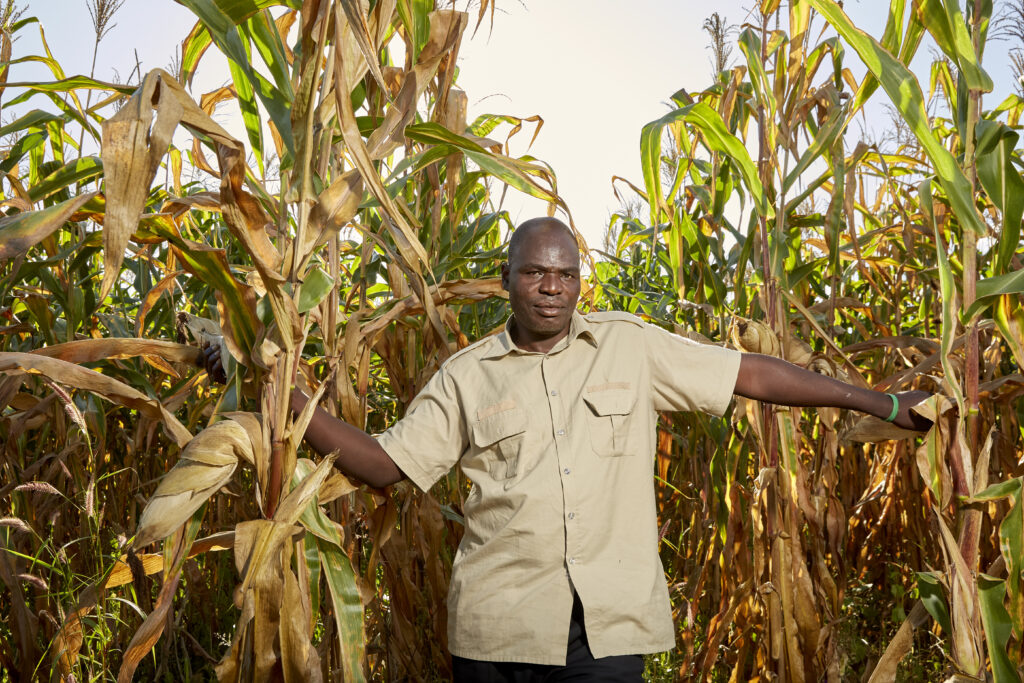
Former poacher Smoke Phiri stands in his maize field in Mwase Mphangwe, Zambia. Photo: Julia Gunther / © IFAW
When I talked to Smoke, and to the other farmers and former poachers we spent time with, they all said the same thing. For people to change, they need a viable alternative. Telling someone to stop poaching when it’s their only source of income, does not work. Lecturing farmers on their destructive farming practices if you don’t show them how to do things differently, does not work. And I can tell you, that after travelling through this remote part of Zambia, where there are precious few markets, where roads are impassable during the rainy season, and where most people run out of food months before they can harvest their next crop, it really is that simple.
This is why COMACO’s approach has been so incredibly effective. If farmers don’t know how to work their land in ways that increases the fertility of the soil, then show them how. If farmers cannot sell their crops because of a lack of access to markets, then create that market.
COMACO retrained Smoke to become a farmer; something he had no experience in – he’d been a poacher since the age of 13. It worked. After being taught new livelihood skills including vegetable gardening, beekeeping, carpentry, poultry and conservation farming, Smoke traded in his .375 rifle and shotgun for a hoe and a few bags of seed, and returned to his home village to start planting. He had undergone a remarkable transformation: from a destructive force to a steward of this important landscape.
Although Smoke is perhaps one of the more dramatic examples of transformation, COMACO doesn’t just focus on poachers. In fact, most of the people they’ve worked with for the past 19 years are traditional farmers who they’ve retrained in smart agricultural techniques; methods, which improve both crop yields and the environment without the use of chemicals or fertilisers.
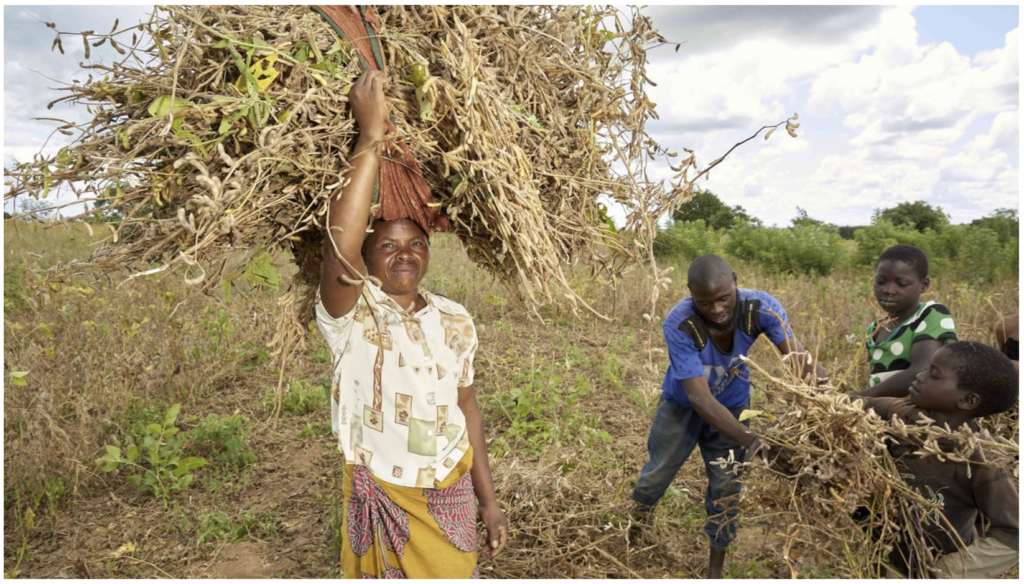
Carrying a pile of harvested soya beans on her head, Grace Mtonga returns to her family village in Chikomeni, Zambia. Photo: Julia Gunther / © IFAW
Everywhere we went, the farmers were keen to tell me what they had learnt. How to till the land as little as possible by using a ripper instead of building ridges, how to use organic material such as leaves or branches as fertiliser, how to plant nitrogen-fixing trees like Gliricidia sepium, and that keeping groundnuts (peanuts) in their shells is a great way to avoid the spread of aflatoxin- a poisonous fungus that if consumed can lead to serious illness or death. These were simple and affordable solutions that helped increase the quality and quantity of the crops they could grow.
After COMACO buys Smoke’s crops at an above the market price, they ship them to their massive factory in Lundazi, the capital of Lundazi district, along with the harvests of thousands of other farmers. On a tour of the plant, we saw warehouses filled with thousands of tons of rice, groundnuts, maize, soya and beans.
There’s a quality control laboratory and a department that develops new products. At one of several milling stations, we met workers who were rushing to finish a 300-ton order of maize and soya porridge mix for Mary’s Meals, an international non-governmental organisation that runs school feeding programs. With 150 tons per month, COMACO is now Zambia’s largest producer of peanut butter. Dozens of COMACO’s It’s Wild! products line the shelves of supermarkets across Zambia. The scale of it all is impressive.
The positive impact of all these transformations is immediately clear. Thanks to projects like this one, small-scale farmers can earn a living, growing nutritious, chemical-free, high-value crops that provide them with income and food security, while learning how to help care for the land and environment they use.
The project, of course, has its challenges. The catchment area is enormous and many of the farmers live in remote villages. And, as with any community project, you never get one hundred percent of people to fully commit. But when you look at everything that this project has solved, any remaining issues seem trivial. The benefits are obvious to most. I think that is because many participating farmers share their experiences with others and help recruit new candidates. Many of COMACO’s fieldworkers are farmers themselves, a key element in building the trust you need when implementing a project of this kind.
Smoke is chair of the Transformed Poachers Association and travels to Lundazi prison to coach incarcerated poachers. The other two former poachers we spoke to, Ronald Mwale and Edison Mphande Phiri (he is not related to Smoke) seemed to be extremely happy to have stopped. Not only do they make more money as farmers, but growing crops is also a lot safer. On the last poaching trip he ever organised, Ronald and four fellow hunters ran into a ranger patrol. During the ensuing firefight, all four of his companions were killed.
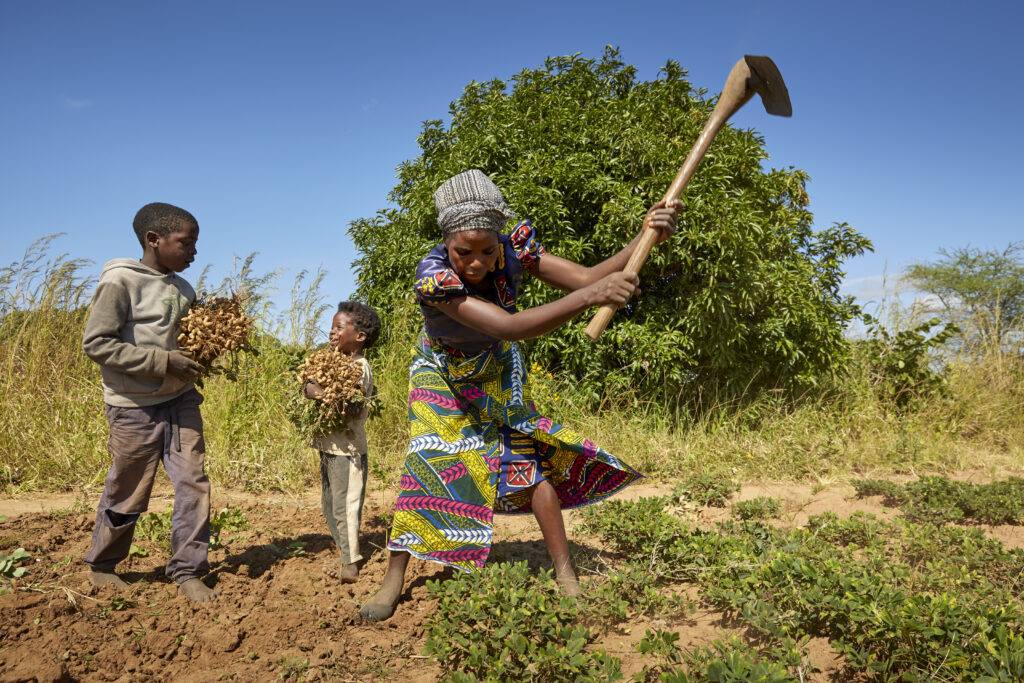
Elita Mwale and her family harvest peanuts on their farm in Chikomeni, Zambia. Photo: Julia Gunther / © IFAW
Elita Mwale, a female farmer with seven children, proudly showed us her new house, her ripper, her two oxen, her ox cart and the shop she was building on land she had bought – all paid for with the money she made by selling her crops to COMACO.
Last year, in 2021, the start of the rains was delayed. Fainess Mgulude could not harvest her crops until later in the season. In previous years, a delayed harvest would have been catastrophic for Fainess, a widow with five children. But since she started using the methods she learnt from COMACO, she has not run out of food once. The delay in rains no longer impacts her as she has enough to last her through the entire year.
There are plenty more examples. You can see the change everywhere in the TFCA. From elephants to sunflowers, from rammed earth to iron sheets, from ridges to ripping, from hunger to surplus, from outlaw to advocate.
But I write about Smoke, Ronald, Edison, Fainess and Elita not for effect or emphasis. I write about them because they deserve to be recognised for the transformation they went through. Because for them, and the many thousands of others whose existence depends entirely on their relationship with the natural world around them, it’s a game-changer.
]]>They are part of a project to improve the income of communities and individual farmers, by training them to farm high-value crops like groundnuts, soybeans and cowpeas and reducing reliance on poaching for bush meat or for profit.
The project targets 3,500 mostly female farmers—1,000 in Malawi and 2,500 in Zambia—across a 32,278 km² part of the Malawi-Zambia Trans frontier Conservation Area (TFCA). The area includes extensive communal lands as well as three national parks, Lukusuzi and Luambe in Zambia and Kasungu in Malawi.
A partnership between the International Fund for Animal Welfare (IFAW), Community Markets for Conservation (COMACO) and funded by the German Agency for International Cooperation (GIZ), has begun recruiting and training 30 local leaders in the TFCA who will, in turn, each train and monitor 83 farmers. Others will learn to identify products such as mushrooms and caterpillars to sell for income and to prevent illegal activities such as poaching and cutting down trees for charcoal.
“Climate change is negatively affecting small-scale farmers in the Lukusuzi/Kasungu TFCA landscape in Zambia and Malawi leading to a loss of income. This can lead to people engaging in poaching of wildlife for subsistence or profit,” said Neil Greenwood, IFAW Regional Director Southern Africa.
“IFAW believes people and animals thrive together. By supporting climate-smart livelihoods in communities in the TFCA, we can improve incomes and protect wildlife from the threat of poaching.”
“The focus of the project is finding practical, cost-effective solutions to the growing challenges of climate change that small-scale, poor farmers face today. It expands on COMACO’s current range of works with 230,000 farmers by identifying 3,500 vulnerable households encompassing mainly women and youth and supporting them with multiple livelihood skills for increased income and food security,” said Dale Lewis, CEO and Founder of COMACO.
Following entirely organic principles COMACO trains farmers in organic principles that includes planting legumes to improve soil nutrition, and to practice crop rotation to keep fields healthy.
Crops are planted alongside Gliricidia sepium trees, which provide additional nutrition to soil and are a natural pest repellent.
“COMACO planted 60 million trees for the 2021-2022 season. Our plan is also to plant 1.75 million trees under this project—500 agroforestry seedlings per 0.25 hectares of farmlands per farmer,” said Dale Lewis.
COMACO will also distribute 1,000 Better Life books to local schools and farmer producer groups in Zambia and Malawi. The book is a local language training manual with colour-printed visual aids covering topics on sustainable agriculture, crop, and agroforestry management.
- COMACO is the sole author and the views expressed are COMACO’s and not those of GIZ.
- “Enhancing Climate Resilience and Cross Border Collaborations in Kasungu/Lukusuzi Trans-frontier Conservation Area (TFCA)” is a project of IFAW and COMACO supported and funded by GIZ.
About the International Fund for Animal Welfare (IFAW)
The International Fund for Animal Welfare is a global non-profit helping animals and people thrive together. We are experts and everyday people, working across seas, oceans and in more than 40 countries around the world. We rescue, rehabilitate and release animals, and we restore and protect their natural habitats. The problems we’re up against are urgent and complicated. To solve them, we match fresh thinking with bold action. We partner with local communities, governments, non-governmental organisations, and businesses. Together, we pioneer new and innovative ways to help all species flourish.
See how at ifaw.org
About the Community Markets for Conservation (COMACO)
The Community Markets for Conservation is a social enterprise that reaches more than 230,000 small-scale farmers in Zambia, 1,800 of whom are reformed poachers, to adopt farming practices that keep soils healthy and forests less threatened by the need to clear trees to create more farmland. It is from these farmers that we pay premium market prices for their crops to manufacture 20 nutritious and high value food products under the brand It’s wild!
See more at staging.itswild.org
Press contact
George Sichinga
COMACO Communications Manager
m: +260 966 494 292
]]>Let’s not kid ourselves. We know we’re losing Nature and we also know the perils that will follow. The COP26 meeting has made that clear. Don’t think others will solve them because they won’t. The terrible waste and plunder of trees in Zambia is unforgiveable. The assault on our soils with chemicals is senseless. The slaughter of wildlife is beyond sadness.
Zambia, these are our actions, and we will pay dearly if we stay on our current collision course. When all is gone and made bare, and the wrath of climate change is showing its full fury, how do we explain ourselves? We welcome help from outside to avoid such calamities, but the tough decisions and hard work must come from within Zambia – our leaders, our farmers, our teachers, our preachers, our youth, all of us.
It is easy to say we must cherish Nature, so we can learn to live with it, nurture it and even enjoy it. Yes, our relationship with Nature can be a positive and beautiful one, but judging from our current state of the environment, we have chosen to fight it, control it, and sadly plunder it.
If we look at ourselves as a Nation and say we can’t continue on our current course, then what can we do? We act.
Government policies and political leaders must force needed change to protect us all. Private sector must abandon practices that waste, pollute and degrade the environment and start to decarbonize their value chains. Consumers, think twice before you throw that plastic bottle out your window or buy that bag of charcoal. Students, be part of the future with innovations that help sustain our balance with Nature. In the end, our economy will thrive when Nature thrives.
Change is not that hard. We just have to do it. Words won’t, but action will. What could be the first steps that could start saving trees, restore depleted soils, and realign our economy with conservation? Here are some starters. They could begin today. We just need the will and the right people and partnerships to make them happen.
- Government discretionary funds support local development needs when communities demonstrate measurable positive change in land and forest protection.
- Zambia Food Reserve offers a premium maize price for communities that adopt sustainable, eco-agricultural practices.
- Zambia National Reserve trains and establishes a Youth Green Corps to help rural communities build local conservation solutions.
- Zambia launches a transition to low-cost, fuel-efficient paraffin cookers to replace charcoal and save Zambia’s forests while more energy-clean alternatives are found.
- Help small-scale farmers adopt the use of fertilizer-producing trees in their fields to restore soil health and provide a sustainable supply fuelwood for cooking.
- Banks and other lending institutions help private sector initiatives with affordable financing that reduce emissions and protect biodiversity.
- Government launches a national program to turn wildlife poachers into viable farmers with an amnesty plus incentive for all illegal firearms surrendered.
- Strengthen market opportunities that help incentivize farmers to care for the land with policy interventions that give better value to farmers for adopting conservation practices.
Community Markets for Conservation, COMACO, has been out there for the past 19 years testing some of these ideas, and they work. It’s time to scale, collaborate, partner, share lessons and show the world that Zambia can act. If public-private partnerships are the answer to help drive this process, then COMACO is ready to sign up and be part of a national team to make conservation happen. No more waiting, it is time to act.
Dale Lewis
COMACO CEO
]]>COMACO sees small-scale farmers as critical to a Zambian Green Economy where commerce grows, biodiversity drives, and greenhouse gas emissions reduce. Making this happen requires a strong partnership between the private sector and small-scale farmers committed to ecologically sustainable practices driven by market incentives. 19 years developing such an approach have given COMACO a strong platform for helping build a Green Economy for Zambia.
We congratulate our new President, H.E. Hakainde Hichilema, for his visionary leadership to reverse years of land degradation and biodiversity loss in Zambia that have dragged rural communities into hardships. With a Green Economy, this does not happen. Instead, a nation prospers in balance with Nature. In this blog we share our approach with insights for a government ready to take the right steps.
Years of misinformation that chemical inputs will sustain smallholders’ livelihoods have proven false and expensive. Failed farms abound that have fueled an urban migration, swelling townships with chronic poverty, leaving others dependent on charcoal or game meat to make ends meet. COMACO is solving these problems.
We first organize farmers into “producer learning groups” and provide year-round training on nature-based ways to replenish soil nutrients and restore life back to the soils. These practices return organic matter, mostly crop residues, back to the soil and use specific tree species to recycle critical nutrients and fix nitrogen to feed the crops. Within 2-3 years we help farmers eliminate the need for chemical fertilizers, which are a major source of greenhouse gases and global warming and can cost farmers as much as 25% of their annual income.
For each of the 86 chiefdoms COMACO supports, we organize these producer groups into cooperatives whose leaders help encourage these practices. COMACO strengthens compliance to these practices by paying farmers premium prices for crops produced in this way to manufacture into our chemical-free, It’s Wild! branded food products. From their annual membership fees, these cooperatives eventually take over farmer training with their own community trainers. To date, COMACO has established 91 such cooperatives. Compared to pre-COMACO statistics, farmer income has more than tripled and food insecurity is far less a risk.
An important outcome is that farmers become sedentary because healthy soils allow continuous harvests, especially if rotation with legume crops is practiced in tandem with soil-enriching trees. COMACO manufactures legumes like groundnuts, soybeans and cowpeas into value-added products to help make this happen. With more sedentary farmers, fewer trees are cut down, and communities are able to benefit from forest products like honey and wild mushrooms, adding more market incentives to forest protection.
This relationship between farmers and forests is a critical one because it underpins another major market opportunity for building a Green Economy – sale of carbon credits. For the past seven years COMACO has helped communities realize these market returns as farmers use their new farming skills to put carbon into the soil and keep carbon in trees by not clearing and burning them. Even consumption of firewood from local forests for cooking is eliminated by using fuel-efficient stoves that COMACO distributes that use off-cuts from the trees that farmers use to fertilize their soils.
COMACO calculates the tonnage of reduced emissions of CO2 relative to emissions would have occurred without these interventions. To date, we have achieved over 4 million tons of reduced CO2 emissions. The amount will likely double over the next three years as more chiefdoms demonstrate their CO2 emission reductions to help fight global warming and be compensated with carbon payments in excess of $2 million annually.
With these positive impacts on farmer incomes, increased community earnings from carbon, and market growth from the sale of It’s Wild! products, COMACO contributes to a net income flow into the Zambian economy of over $10 million annually. We estimate a comparable potential amount saved by avoided fertilizer costs. COMACO’s ability to sustain and scale this level of impact is made possible because it operates in Zambia as a non-profit social enterprise. COMACO’s goal is to make conservation profitable for small-scale farmers and not make profits for itself. Our bottom-line target is sustainability.
COMACO is ready to join our new Zambian President to help bring a Green Economy to the Zambian people to a national scale. For 19 years COMACO has waited for this opportunity. It is an auspicious time for conservation where we can all unite – traditional leaders, farmers, private sector, and consumers – to help our President on this important journey.
Dale Lewis, CEO
]]>
Short-term commercial interests may have been satisfied for some, but for the small-scale farmer, change was needed to head-off the environmental costs that were making life hard. COMACO stepped in to fill this need. If small-scale farmers could learn the biology of soils as the basis for understanding and applying more sustainable agriculture, then farmers could be the solution to the growing problem of land degradation that was unfolding in Zambia. We took on this challenge by developing market incentives for farmers who made the change and the It’s Wild! brand was born to help drive farmers commitment to farm with nature, not against it. Over 230,000 small-scale farmers are seeing the benefits of this approach today. It combines crop residue protection from fire and livestock grazing, minimum tillage, maize rotation with legumes, and inter-cropping with special trees that help pump up water and minerals to keep crops healthy. Underneath the soil surface, a real transformation is taking place as living microbes are reestablishing the nutrient cycles so critical for feeding crops. We know this as we analyze and compare soil nutrients and nutrient content in crops for fields farmed in this way versus fields farmed with chemicals. Above the ground, farmers are transforming as well, organizing themselves into cooperatives to help farmers learn together to encourage the adoption of these new practices for higher yields and income.
There is a bigger picture, however, that is beginning to take shape, one that is especially important for Zambia. Cooperatives and their leaders are taking more responsibility for their entire landscape as improved knowledge of soils and a growing culture of self-management are extended more broadly to address deforestation and biodiversity loss. By working collectively as a cooperative, farmers can more easily share knowledge of what soils and the land can and cannot sustain for their future well-being. This has built a foundation for local leaders to self-impose rules and regulations for the protection of not just their soils but for the natural assets within their chiefdom. They are called Community Conservation Plans and a body of local leaders presided by the local chief monitor their compliance and enforce with penalties when violations are judged and charged.
We observe with growing excitement how farmers and nature can work together, strengthening their potential bonds of interdependence to allow the diverse and rich wealth of organisms the land can support to better support farmer livelihoods as well.
]]>