In a few days, #COP27 in Egypt will bring Heads of State and thousands of people together to decide the future of #ClimateAction. Zambia is the Chair of the Africa Group of Negotiators for COP27 and COMACO will be presenting a session titled “Farmers, Carbon Markets, and A Model Scaling for Climate Solutions” to lead the way in catalysing positive change for all key stakeholders. #COMACO@COP27https://youtu.be/Wnc7bYYUi3M
]]>I reached in my pocket and passed him a K20 (about $1.04) through the window just as the light turned green and I drove away. After a few minutes more driving toward home I confessed to myself: I could easily have given him a K100 and should have. He needed the money more than I. It was selfish of me.
I started to imagine the life that little boy lived. How many nights did he go to bed hungry? Did he go to school? Were his parents still alive or simply too poor to care for him? I knew he was not alone. I see many standing along the streets, sometimes early in the morning as if they have woken from some secret place to begin another day of begging.
COMACO works with close to 200,000 small-scale farmers to manufacture surplus food crops into healthy, nutritious products and distribute them to retail stores all over the country. It struck me that the reality, however, is that few of these products, which we produce from surplus after the farmers have fed their own families, reach others truly hungry and malnourished people. The products on retail shelves tend to be expensive, and these stores are too far away from where poverty and hunger grind away in Zambia’s towns and cities. While revenue from those products helps fund our food and conservation initiatives with rural poor and provides nutritious local foods to middle and upper-class urban consumers, our system does not serve the urban poor very well.
The chance encounter with that boy got me thinking, and soon a discussion spread among our staff. We might not be able to feed every street kid, but we could at least try to get our nutritious and tasty products to more of the urban poor at prices they can afford.
With a determined staff and deep convictions, COMACO is now launching a new business model that links our farmers directly to low-income consumers in this way, offering the same quality products but making them significantly cheaper and more available to these populations. By modifying our packaging, initiating direct sales through tiny neighborhood shops, and using new mobile apps for quality control, we’ll be able to lower the price by as much as 20%. This will give It’s Wild! products a reach we’ve never had before. Our new “Green Market Shops” will wholesale directly to the small shops where low-income consumers in need can easily find our products at affordable prices.
It’s a Zambian farmer-to-consumer solution, and a viable business model with soul. It also further supports our success regenerating soils and restoring forests in ways that both nourish the hungry and keep the environment healthy. In ways like this, COMACO keeps trying to get it right. If there had not been that red light and young boy in Lusaka, we might have missed this chance to do it better.
For helping us get our new model off the ground, I wish to thank the Zambia Bureau of Standards for allowing our innovations to reduce product costs, Partners in Food Solution for helping us develop new nutrient-rich products, and especially the Green Innovation Centres for the Agriculture and Food Sector (GIC) for supporting our efforts to scale our Green Market Shops.
]]>Again, and again, their message is clear: Nature is the solution if we can only learn to live with it, and above all, not destroy it. COMACO is rich with stories about people who believe in conservation, and Farm Talk gives them the chance to share their knowledge. Our own Filius Jere pioneered COMACO Farm Talk to build this discussion over the airwaves. With a small team of dedicated radio producers, Filius has helped to make COMACO a household name and perhaps the real “Green Revolution” for Zambia.
In his words…
“Farm Talk reaches into the homes in the evening or beneath a mango tree during the day when farmer groups gather to tune to Farm Talk with one of COMACO’s 20,000 radios from Lifeline Energy. From the programs we air, they’re learning how to avoid past mistakes that have cost them their soils, forests, and wildlife. Farm Talk gives them the skills and the confidence to bring back what they have lost. Nature is now our life and our future.”
Dale Lewis, CEO |Connect with me on LinkedIn ]]>
Background on the carbon project
We began working with the World Bank in 2015 to develop Zambia’s first large-scale Reducing Emissions from Deforestation and Forest Degradation (REDD+) carbon project. The project started as a pilot initiative with nine chiefdoms. We set in place a monitoring system that determines how much CO2 emissions are saved by avoided deforestation as a result of our Community Conservation Areas (CCAs). Through a carbon offset scheme, communities are then paid for their conservation efforts. In the first monitoring period, 228,000 tonnes of CO2 emission reductions were recorded, which paid out $490,000 to the participating chiefdoms.
COMACO, with independent evaluation from AENOR, began evaluating the actions and effect of our reduce emissions from deforestation and forest degradation (REDD+) carbon project. The aim of REDD+ is to encourage developing countries to contribute to climate change mitigation by reducing their greenhouse emissions (GHC), halting and reversing the loss of forests and degradation. The other objective is to increase the rate at which we are removing GHCs from the earth’s atmosphere through conservation, natural resource management and expanding existing forests.
In the first monitoring period, 228,000 tonnes of CO2 emission reductions were recorded, which paid out $490,000 to the participating chiefdoms.
The carbon revenue has been invested in community development projects, such as the drilling of new wells in regions with limited access to clean water, or the launch of additional incomes sources like community poultry farming and bee keeping.
Evaluation is an important element of the monitoring and evaluation of the effectiveness of this project. As we expand our REDD+ carbon project in Zambia, this assessment gives us solid evidence of the effect our project is having in the action to fight deforestation and
The 4th Congress Hidden Hunger brings together members of different disciplines: nutritionists, agricultural scientists, economists and sociologists. Moreover, the Congress will encourage the dialogue between scientists, policy-makers and representatives of non-governmental organizations and the private sector. It is dedicated to review the available evidence on the double burden of malnutrition, present new research findings on underlying causes and consequences, feature innovative strategies and discuss the roles and responsibilities of governments, development organizations, civil society and the private sector in combating the double burden of malnutrition.
COMACO has been involved with community-based conservation in the Luangwa Valley for the last 15 years, and in partnership with organizations such as Norwegian Agency for Development Cooperation (NORAD), collaborators in local government and other committed partner organizations and donors, COMACO is able to continue working with rural communities to help them increase their food security. When we increase food security, it boosts their self-sufficiency to generate community-level income without endangering local wildlife and other natural resources by using climate-smart, sustainable agriculture methods.
As a result, interest in climate-smart agriculture with a minimum of soil tillage is gaining ground, and Zambia is at the forefront of Africa’s smallholders in this respect.
In adopting sustainable farming methods, smallholder farmers are less likely to resort to harmful practices that lead to deforestation caused by the production of charcoal, clearing of new land for agriculture and illegal logging.
COMACO’s programs also provide smallholder farmers with various market incentives, some of which are tied to the sale of our It’s Wild! food products – a popular food brand in Zambia.
]]>Thanks to USAID Zambia’s generous donation of 16 desktop computers, we are able to make this happen and will be conducting hands-on training in the third week of January to the chiefs in our Chipata Hub office.
As a non-profit, COMACO relies on institutional support to expand and innovate our services to continue to advance conservation in Zambia. Our grantors provide us with necessary funds and collaboration that enable COMACO to pilot new conservation programs and serve new communities.
We’re grateful for these investments and the generous support of our individual investors. We are also appreciative of the substantial technology contributions of all our donor partners such as USAID. We would like to send special thanks to Daniel L. Foote, the American Ambassador in Zambia, for his instrumental role in supporting the computers for chiefs campaign and for USAID’s continued support to COMACO.
The 16 chiefs we selected for this initiative have demonstrated a keen desire to make wildlife conservation a priority agenda and leverage their powers as traditional leaders to prevent further loss of natural resources on their land and wildlife and thus restore what has been lost.
These desktop computers will be loaded with a geographic mapping program which will allow chiefs to view real-time incidence of fires, deforestation, environmental trends and other data gathered within their chiefdoms.
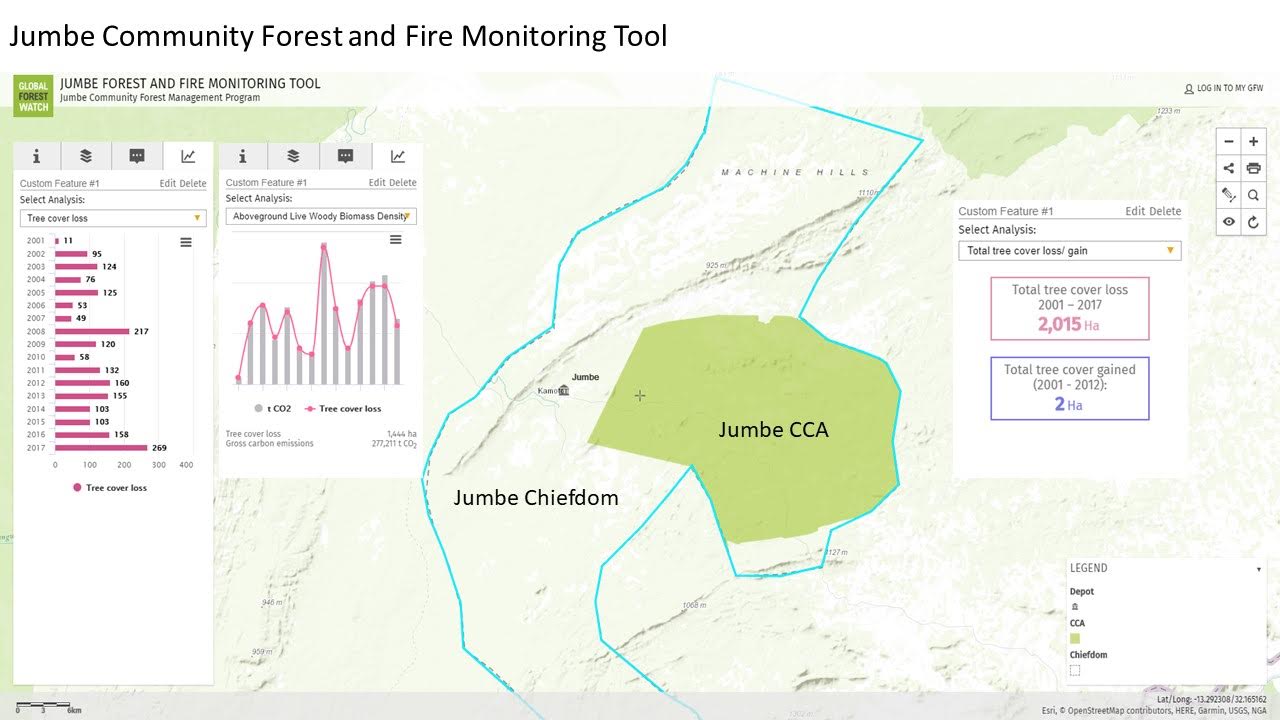
We’re excited to begin two days of training in the use of this computer program for the 16 selected Chiefs in our Chipata Hub. They will be mentored by Japhet Seulu and Angel Mukangu, COMACO’s GIS experts. The data we obtain will be used to assess conservation trends affected by COMACOs initiatives. The Computers-for-Chiefs Initiative will also help us share more accurate mapping information resulting from the management decisions and delegated efforts by members of the community to influence these trends. We’ll be able to track and visualize changes to the physical landscape in these areas and make decisions to mitigate negative trends such as deforestation, or forest fires.
To date, 38 Community Conservation Areas (CCAs) on 954, 455 hectors of forest land have been formed and are under community protection in 34 chiefdoms. This initiative is vital because it will help us continue to scale up climate mitigation and socioeconomic development simultaneously through community engagement and collaboration with government.
Because of continued help from our generous supporters, we are able to continue advocating for conservation by leading efforts to promote sustainable agriculture through our community cooperatives in Zambia. Your support will help COMACO achieve a lasting mark for conservation in Zambia’s most vulnerable chiefdoms.
––––––––––––––––––––––––––––––––––––––––––––––––––––––––––––
You can help!
Together, we can continue to be powerful enablers for social change, and we have developed sustainable, community-driven conservation solutions to meet the most urgent challenges. Your contributions make sure that COMACOs is well-positioned to take on conversation issues and expand our impact by making a donation today. We also invite you to sign up for our email list so that you’ll be able to track our progress and other news.
For more information, queries, and donations, please email mkambinda@staging.itswild.org. or go to www.staging.itswild.org/about
UPDATE: Thanks to a donation from USAID, we were able to secure 16 desktop computers. You can read more about it in this blog post.
Dear COMACO Supporter,
COMACO has a 15 year history of supporting bottom-of-the-pyramid farmers across Zambia’s Luangwa Valley, home to some of Africa’s most important wildlife populations. Working with traditional leaders, or Chiefs as they are locally known, is pivotal to COMACO’s work in order to advance more progressive thinking about land management and resource protection. 
From these relationships, COMACO has identified 16 chiefs that have demonstrated a real desire to take wildlife conservation seriously and leverage their traditional powers to prevent further degradation of natural resources on their land and restore what has been lost.
We are aiming to provide these 16 Chiefs with second-hand computers in order to further assist these 16 Chiefs in pursuing conservation efforts in conjunction with COMACO.
These laptops will be loaded with Global Forest Watch, which will allow chiefs to view real-time incidence of fires, deforestation, and environmental trends in their chiefdoms. The selected Chiefs will be mentored by Japhet Seulu and Angel Mukangu, COMACO’s GIS Specialists, to use this information to assess their efforts and relate management decisions and delegated efforts by members of the community to influence these trends.
If you have a spare computer you would like to donate to COMACO’s Computers-for-Chiefs Initiative, we will be receiving through October 5 to the following address:
Dale Lewis
12510 Sanford Street
Los Angeles, CA 90066
We thank you in advance for your consideration and your gracious donation. Your support will help COMACO achieve a lasting mark for conservation in Zambia’s most vulnerable chiefdoms. For more information, queries, and donation within Zambia, please email obell@staging.itswild.org.
Yours sincerely,
Dale Lewis
CEO and Founder of COMACO
]]>Dear Supporters of COMACO and It’s Wild!,
As the Founder and CEO of COMACO, I’d like to personally thank everyone who visited our stand at the 2018 Agricultural and Commercial Society of Zambia (ACSZ) Show. We estimate that over 6,000 people passed through our stand, and it was our pleasure to interact with each and every one of you.
We are always improving to serve you, the customer, as well as the farmers that produce our products. At the ACSZ Show, we explained how COMACO’s It’s Wild! brand of healthy food products drives market incentives for farmers to adopt practices help protect the environment, wildlife, trees, and soils of the Luangwa Valley.
We shared with you our commitment to continue making our It’s Wild! products, which are healthy, nutritious and tasty. We explained we do this to keep our close partnership with small-scale farmers alive and growing because of the great service they can provide to conservation when market gives them a good deal for doing so.
We heard your vote of confidence in COMACO’s vision and saw your support for It’s Wild! products. We are overwhelmed with gratitude for the trust you have put in our brand.
Additionally, we are delighted and honored to announce that COMACO has won a two first place prizes at the Ag Show:
- Best Non-Governmental Organisation
- Best “Made in Zambia” Product
We are so humbled to have won these two 1st place awards against such strong competition. We share this honor with you and thank you for all your overwhelming support.

Additionally, we were especially honoured that His Excellency the President of the Republic of Zambia Edgar Chagwa Lungu took the time to learn about COMACO’s work. It was our privileged to tell President Lungu about our impact in the Luangwa Valley and to show him our delicious It’s Wild! products.

Further, we would like to thank the entire COMACO team, the staff and judges, the team at ACSZ, as well as the staff and judges of the awards. And, very importantly, we’d like to thank you, our consumers, whose continued support makes the mission and work of COMACO and It’s Wild! possible.
Sincerely,
Dale Lewis
Founder and CEO of COMACO
[/vc_column_text][/vc_column][/vc_row][vc_row parallax_bg=”tcsn-parallax”][vc_column]
]]>