Written by Nick Schonfeld
Smoke Phiri looks like an archetypal henchman. His massive frame towers over his family of nine children. At 50 years old, he seems to have lost none of his strength or virility. As he talks, he gestures confidently with large calloused hands. Smoke is, frankly, a little intimidating. And that’s not surprising, because for two decades, Smoke was a prolific poacher.
Photographer Julia Gunther and I met Smoke while on an IFAW/COMACO project visit to Chikomeni and Mwasemphangwe chiefdoms in eastern Zambia, which form part of the Malawi-Zambia Trans frontier Conservation Area (TFCA). Mostly aimed at female farmers and poachers, the project is a new partnership, started in 2021, between IFAW and COMACO, and is funded by the German Agency for International Cooperation (GIZ).
As is often the case with multi-partner projects, the name is a bit of a mouthful: “Enhancing Climate Resilience and Cross Border Collaborations in Kasungu/Lukusuzi Trans-frontier Conservation Area (TFCA)”. But its goals are both ambitious and very necessary.
Populated mainly by small-scale, low-income farmers, Chikomeni and Mwasemphangwe chiefdoms are squeezed in between Lukusuzi National Park on the left and Kasungu National Park in Malawi on the right. The two chiefdoms are part of a wildlife corridor between the unfenced parks across which buffalo, hyenas, elephants and countless other species travel up and down throughout the year.
Chronic food insecurity, driven by worsening climate change and the absence of a market for farmers to sell their crops, has forced many into poaching or illegal mining. Those who choose not to, struggle to feed their families for large parts of the year. Add to that the fact that most nights wild animals wander through the farms on their way to or from Kasungu or Lukusuzi, and that farms offer an irresistible supply of food for wildlife, and you have all the ingredients for a classic human-wildlife conflict that makes it very difficult for communities to live in harmony with nature.
Every farm we visited had a corral made of sturdy logs and branches where villagers kept their cattle during the night. Goats were housed on raised platforms and in some places, harvested crops were stored off the ground on drying racks. If left unprotected, jackals or hyenas would cause havoc.
It’s no surprise that the TFCA was a prime hunting ground for poachers like Smoke, who told me he used to kill one or two elephants a week, as well as buffalos, kudu and warthogs. He would sell the ivory as quickly as he could. The bush meat would be eaten or sold at local markets. But that was almost twenty years ago. Smoke stopped poaching in 2003. The reason Smoke stopped is why we are here talking with him in front of his red brick house, surrounded by the fields of sunflowers, soya beans and groundnuts he now grows.
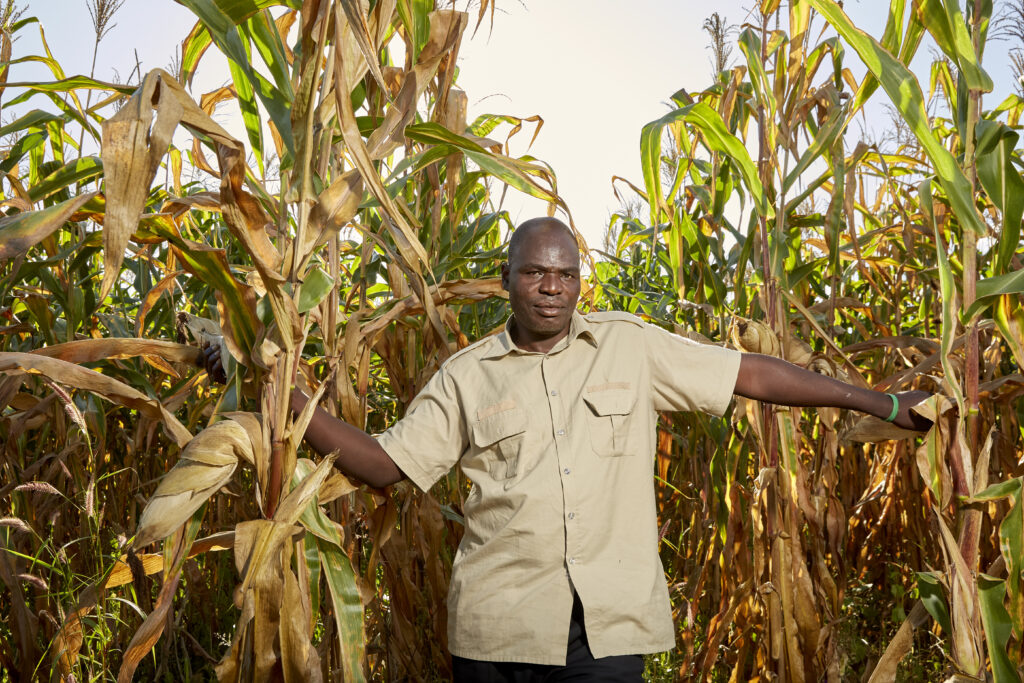
Former poacher Smoke Phiri stands in his maize field in Mwase Mphangwe, Zambia. Photo: Julia Gunther / © IFAW
When I talked to Smoke, and to the other farmers and former poachers we spent time with, they all said the same thing. For people to change, they need a viable alternative. Telling someone to stop poaching when it’s their only source of income, does not work. Lecturing farmers on their destructive farming practices if you don’t show them how to do things differently, does not work. And I can tell you, that after travelling through this remote part of Zambia, where there are precious few markets, where roads are impassable during the rainy season, and where most people run out of food months before they can harvest their next crop, it really is that simple.
This is why COMACO’s approach has been so incredibly effective. If farmers don’t know how to work their land in ways that increases the fertility of the soil, then show them how. If farmers cannot sell their crops because of a lack of access to markets, then create that market.
COMACO retrained Smoke to become a farmer; something he had no experience in – he’d been a poacher since the age of 13. It worked. After being taught new livelihood skills including vegetable gardening, beekeeping, carpentry, poultry and conservation farming, Smoke traded in his .375 rifle and shotgun for a hoe and a few bags of seed, and returned to his home village to start planting. He had undergone a remarkable transformation: from a destructive force to a steward of this important landscape.
Although Smoke is perhaps one of the more dramatic examples of transformation, COMACO doesn’t just focus on poachers. In fact, most of the people they’ve worked with for the past 19 years are traditional farmers who they’ve retrained in smart agricultural techniques; methods, which improve both crop yields and the environment without the use of chemicals or fertilisers.
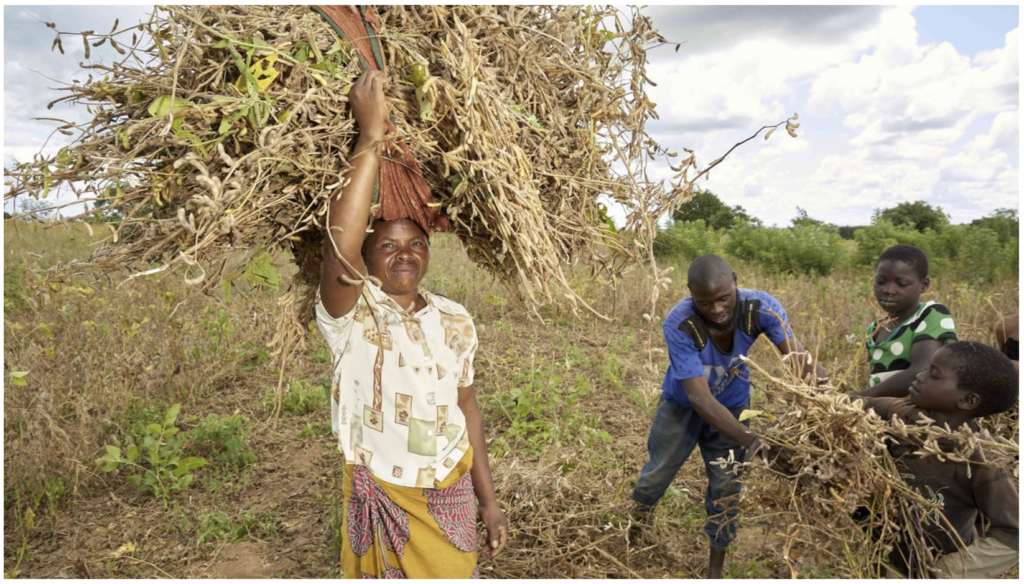
Carrying a pile of harvested soya beans on her head, Grace Mtonga returns to her family village in Chikomeni, Zambia. Photo: Julia Gunther / © IFAW
Everywhere we went, the farmers were keen to tell me what they had learnt. How to till the land as little as possible by using a ripper instead of building ridges, how to use organic material such as leaves or branches as fertiliser, how to plant nitrogen-fixing trees like Gliricidia sepium, and that keeping groundnuts (peanuts) in their shells is a great way to avoid the spread of aflatoxin- a poisonous fungus that if consumed can lead to serious illness or death. These were simple and affordable solutions that helped increase the quality and quantity of the crops they could grow.
After COMACO buys Smoke’s crops at an above the market price, they ship them to their massive factory in Lundazi, the capital of Lundazi district, along with the harvests of thousands of other farmers. On a tour of the plant, we saw warehouses filled with thousands of tons of rice, groundnuts, maize, soya and beans.
There’s a quality control laboratory and a department that develops new products. At one of several milling stations, we met workers who were rushing to finish a 300-ton order of maize and soya porridge mix for Mary’s Meals, an international non-governmental organisation that runs school feeding programs. With 150 tons per month, COMACO is now Zambia’s largest producer of peanut butter. Dozens of COMACO’s It’s Wild! products line the shelves of supermarkets across Zambia. The scale of it all is impressive.
The positive impact of all these transformations is immediately clear. Thanks to projects like this one, small-scale farmers can earn a living, growing nutritious, chemical-free, high-value crops that provide them with income and food security, while learning how to help care for the land and environment they use.
The project, of course, has its challenges. The catchment area is enormous and many of the farmers live in remote villages. And, as with any community project, you never get one hundred percent of people to fully commit. But when you look at everything that this project has solved, any remaining issues seem trivial. The benefits are obvious to most. I think that is because many participating farmers share their experiences with others and help recruit new candidates. Many of COMACO’s fieldworkers are farmers themselves, a key element in building the trust you need when implementing a project of this kind.
Smoke is chair of the Transformed Poachers Association and travels to Lundazi prison to coach incarcerated poachers. The other two former poachers we spoke to, Ronald Mwale and Edison Mphande Phiri (he is not related to Smoke) seemed to be extremely happy to have stopped. Not only do they make more money as farmers, but growing crops is also a lot safer. On the last poaching trip he ever organised, Ronald and four fellow hunters ran into a ranger patrol. During the ensuing firefight, all four of his companions were killed.
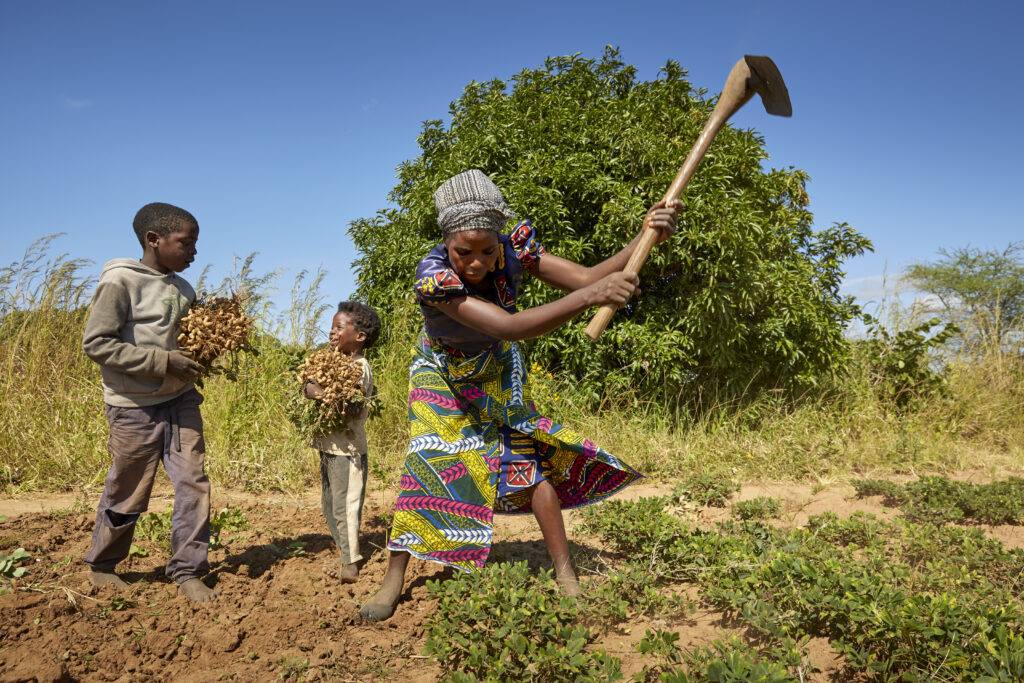
Elita Mwale and her family harvest peanuts on their farm in Chikomeni, Zambia. Photo: Julia Gunther / © IFAW
Elita Mwale, a female farmer with seven children, proudly showed us her new house, her ripper, her two oxen, her ox cart and the shop she was building on land she had bought – all paid for with the money she made by selling her crops to COMACO.
Last year, in 2021, the start of the rains was delayed. Fainess Mgulude could not harvest her crops until later in the season. In previous years, a delayed harvest would have been catastrophic for Fainess, a widow with five children. But since she started using the methods she learnt from COMACO, she has not run out of food once. The delay in rains no longer impacts her as she has enough to last her through the entire year.
There are plenty more examples. You can see the change everywhere in the TFCA. From elephants to sunflowers, from rammed earth to iron sheets, from ridges to ripping, from hunger to surplus, from outlaw to advocate.
But I write about Smoke, Ronald, Edison, Fainess and Elita not for effect or emphasis. I write about them because they deserve to be recognised for the transformation they went through. Because for them, and the many thousands of others whose existence depends entirely on their relationship with the natural world around them, it’s a game-changer.
]]>Forests cover 31% of the land area on our planet and up to eighty percent of the world’s land-based species, such as elephants and rhinos, live in forests.
This past year COMACO came to Loveness‘s village to buy rice, a common crop for the area. It was the first time she and her husband have ever experienced a cash market. Previously, traders bartered their crops for cheap merchandise. It was only game meat that was sold across the border to DRC where her husband could earn money. Though he had never been arrested, he knew the risks could send him to prison.
Loveness describes the decision she and her husband recently made to avoid this fate, “when COMACO paid for our rice and showed us how much it was worth when we practice the farming skills we were taught, I told my husband it was better to stop poaching and he agreed to surrender his firearm. We can understand conservation now because COMACO has given us markets.”
Since COMACO began operations, 1,780 farmers like Loveness‘s husband have surrendered their firearms voluntarily, but the conservation problem is much greater than just poaching wildlife. It is also the environmental harm that farming causes when the wrong way of farming depletes soil nutrients and forces farmers to clear more land, resulting in fewer forests and less habitat for wildlife. This is the conservation crisis Zambia faces today.
Over 1,780, farmers like Loveness‘s husband have surrendered their firearms voluntarily since COMACO began working in Zambia.
Reversing this problem on a scale that can have an impact requires a collective effort by hundreds of thousands of farmers motivated to heal their land with farming practices that allow farmers to keep farming the same plot productively and indefinitely. COMACO is proving this is possible when market incentives and cost-savings drive the transformation.
Conservation business
This year, for example, there are over 61% of farmers that are doing “conservation business” with COMACO will be planting over 36 million agroforestry trees to help repair their soils. Not only are these farmers making significant cash savings by not having to buy expensive chemical fertilizers, but they are also building up carbon in the soil by sucking CO2 out of the air. Soil carbon is a key ingredient to healthy soils and can add additional revenue from the sale of this carbon as carbon credits on the open carbon market. Not only is COMACO helping farmers to realize this added carbon value by adopting an agroforestry farming system, but it is also helping 5,000 of its groundnut farmers to become organically certified producers to gain additional income from better-paying export markets.
With this emphasis on the needs of farmers and the resources they live with, COMACO has taken the long, hard road in building a viable business to serve conservation first and profits second. By staying the course, COMACO is proving the two can serve each other to find a more lasting solution for conservation.
]]>It took time and research for COMACO to figure things out, but today we see a better story unfolding. Farmers have learned that composting and intercropping legumes or growing them in rotation with maize boosts crop yields. In addition, planting crops in-between rows of nitrogen-fixing trees positively impacts the economics for small-scale farming communities.
 Using this approach, farmers can reduce the majority of the costs associated with expensive chemical inputs. Instead, they use a nitrogen-fixing tree called Gliricidia sepium that helps return soil health and is also a sustainable source of wood-fuel for cooking and heating needs. Today’s conscious consumer is looking for healthier food products, and with the right partners, we can provide market opportunities that reward rural farmers for making the shift sustainable agriculture methods.
One of the key roles we play in this value-chain is processing the pesticide-free crops from small-scale farmers into high-value food products sold under the It’s Wild! brand. We also provide access to commodity markets that pay top prices for crops grown without chemicals. COMACO also helps rural farming communities through their cooperatives to produce certified seeds which they sell at a reduced cost to its members. Community seed-banking also guarantees they can select high-yielding seeds that are GMO-free and bring essential market value to small-scale farmers
Meanwhile, what has happened to all those poachers? Many have found a better life as COMACO farmers, gaining a sustainable and legal means of income generation plus food security. Today, COMACO has over 186,000 registered farmers. Among these farmers, 1,653 were once poachers but have now surrendered their guns to learn sustainable farming methods. The added benefit is that they are assured a ready market by COMACO.
Zambia now has a way to turn crops into the answer to stopping elephant poaching! It may sound far-fetched but speak to any rural farmer and they will tell you that the COMACO model makes conservation pays. No longer are unsustainable practices that destroy their natural resources needed. It’s not sustainable. Ask the consumers, and more likely than not, they will say that It’s Wild! products are worth the purchase because they’re an organic food brand rooted in conservation and enhances food security for rural communities, number 2 of the SDG goals.
]]>
Interestingly, Andrew Maimisa is not a COMACO farmer but an ardent follower and listener of COMACO’s Farm Talk radio program. “I listen to COMACO programs on radio Breeze FM and I have heard testimonies from a lot of farmers that have had their lives transformed because of the work COMACO does to empower rural farmers. I also want to be part of this winning team; I am old and I have realized that I need to channel my remaining energy into farming and not go into the bush to hunt game illegally. After listening to many testimonies from transformed poachers shared on Farm Talk radio and learning that my Zambia earns a lot of forex from tourists who visit to see our wild animals, it convinced me to voluntarily give up my firearm” Maimisa said.

He further urged to COMACO to help him with beehives so that he can now concentrate on beekeeping and soybeans farming. And receiving the surrendered firearm from COMACO, the Department of National Parks and Wildlife area warden Erastus Kancheya, thanked COMACO for the good incentives that they continue to give to farmers who in turn and, motivate poachers to quit have become friends of wildlife. “As the DNPWL, we are humbled to have a partner like COMACO who are helping reduce the levels of poaching in Zambia. My appeal goes to those that still have firearms and traps to take them to COMACO or to surrender them at any of our provincial offices.”Kancheya said. He further warned those that are still in the habit of poaching that their time will come and that the long arm of the law will take its course.
]]>Illegal trafficking halted…
A fuel-efficient cookstove that uses the small branches of a tree species called Gliricidia sepium is helping many thousands of smallholder farming families across Zambia’s Luangwa Valley have a better life and create more space for wildlife.
It is a story that started when we realized how farming practices were keeping farmers poor and often hungry by draining soils of their nutrients. The results were lower yields, more land clearing, and a growing dependency on poaching for game meat to make ends meet. From the delicate bushbuck to the magnificent elephant, no species was spared.
When you live in Africa and admire the way forests and grasslands coexist and grow so productively, you wonder if the same coexistence could not be applied to farmland – that is to say, growing crops with trees. Perhaps Nature has a solution that is staring in our face.
What is needed is a tree that grows quickly, fixes nitrogen in the soil, draws up critical micronutrients from its roots, increases crop yields, and is easy for smallholders to plant as a replacement to fertilizer. COMACO found the right tree: Gliricidia sepium. That was eight years ago.
Today over 60,000 small holders are using Gliricidia and achieving yields comparable to yields produced with chemical fertilizers. With the help of COMACO, over 25 million seedlings are planted annually in farm plots across the Luangwa Valley ecosystem. In reality, we’re recreating the African savannah but with food crops!
With low input costs made possible by Gliricidia and helped along by the good market prices that COMACO offers for crops when farmers use sustainable farming practices, smallholder farmers, many of whom once poached, are now making a profit farming. In turn, COMACO manufactures the crops it buys from these farmers into a range of healthy, chemical-free food products it sells under the brand, It’s Wild! and the proceeds help to sustain the process. But there is more to the story than increasing yields, helping farmers out of poverty, and turning poachers into farmers.
The same tree is also an excellent source of fuel wood. At the time when farmers begin to plant their crops, they cut these trees knee height to allow sun exposure to emerging crops. The process is called coppicing and the trees grow back in several months. The cut stems, referred to as off-cuts, become a potential source of firewood for cooking. This reduces the need for women to walk long distances to cut wood from local forests. It is also in these forests where local residents in search of firewood risk injury from wild animals. It does happen, from snake bites to an accidental and sometimes fatal encounter with an elephant or lion.
What if there were a more efficient way of burning Gliricidia off-cuts for cooking so that women would never have to go in search of firewood from forests? Think of the time women could save to care for their children, garden or raise more chickens.
The story continues. COMACO, together with its partner, CQuest, introduced a fuel-efficient stove with only three metal parts and built with locally molded bricks. We were unsure whether families, particularly women, would accept these stoves and give up their traditional way of cooking over open fires using logs extracted from their local forests. We quickly realized we had a solution and a way of linking sustainable agriculture to sustainable fuelwood production that reduces pressures on habitat and removes the need to poach wildlife.
Thousands of farmers, mostly women, are now harvesting a full year’s supply of fuel wood from their farm plots in just 1-2 days as compared to over 30-32 days of gathering the same supply of firewood from nearby forests. We estimate that Gliricidia as an alternative source of firewood is reducing annual tree loss by at least 5-7 trees per family. This may not seem like much, but accumulatively over time, COMACO is literally saving forests and ultimately an entire watershed if we can continue to scale the adoption of Gliricidia-based farming.
Today, over 80,000 of these stoves are in use. They are perfectly designed for burning more efficiently the relatively small-stem off-cuts of Gliricidia and bringing relief to women who can now avoid the ill-effects of cooking over open fires and breathing the toxic smoke fumes. Such benefits are accelerating the adoption of Gliricidia as a way of supporting family food needs and increased incomes.
Innovative technologies that mimic nature, a little ingenuity, and market incentives that help drive the process are transforming the lives of smallholder farmers and tipping the balance toward safer forests and less threatened wildlife. The story is not finished, however. The final story will be told when Gliricidia and its partner cookstove are an integral part of an evolving ecology of the Luangwa Valley ecosystem that will ensure such wild animals like the elephant have a secure place in Africa’s future.
You can help us make this future happen. We have set up a special fund-raising drive that supports farmer prosperity, wildlife conservation and climate change management. The program will include teaching farmers to plant nitrogen-fixing trees with their food crops and supplying efficient cookstoves which use surplus wood produced by these trees. This will create a virtuous cycle of higher food yield, higher incomes which then translate to reduced poaching and more climate resilient ecosystems that benefit the local community as well as the global ecosystem.
Thank you!
Dale Lewis, COMACO CEO
]]>UPDATE: Thanks to a donation from USAID, we were able to secure 16 desktop computers. You can read more about it in this blog post.
Dear COMACO Supporter,
COMACO has a 15 year history of supporting bottom-of-the-pyramid farmers across Zambia’s Luangwa Valley, home to some of Africa’s most important wildlife populations. Working with traditional leaders, or Chiefs as they are locally known, is pivotal to COMACO’s work in order to advance more progressive thinking about land management and resource protection. 
From these relationships, COMACO has identified 16 chiefs that have demonstrated a real desire to take wildlife conservation seriously and leverage their traditional powers to prevent further degradation of natural resources on their land and restore what has been lost.
We are aiming to provide these 16 Chiefs with second-hand computers in order to further assist these 16 Chiefs in pursuing conservation efforts in conjunction with COMACO.
These laptops will be loaded with Global Forest Watch, which will allow chiefs to view real-time incidence of fires, deforestation, and environmental trends in their chiefdoms. The selected Chiefs will be mentored by Japhet Seulu and Angel Mukangu, COMACO’s GIS Specialists, to use this information to assess their efforts and relate management decisions and delegated efforts by members of the community to influence these trends.
If you have a spare computer you would like to donate to COMACO’s Computers-for-Chiefs Initiative, we will be receiving through October 5 to the following address:
Dale Lewis
12510 Sanford Street
Los Angeles, CA 90066
We thank you in advance for your consideration and your gracious donation. Your support will help COMACO achieve a lasting mark for conservation in Zambia’s most vulnerable chiefdoms. For more information, queries, and donation within Zambia, please email obell@staging.itswild.org.
Yours sincerely,
Dale Lewis
CEO and Founder of COMACO
]]>To address this growing problem, COMACO, in partnership with ZAWA (the Zambian Wildlife Authority) has established regional troops of volunteer “Chiliblasters,” who operate in the model of a volunteer fire department, except instead of fighting fires they fight crop disturbance by elephants.[/vc_column_text][blockquote style=”left_border” font_size=”24px” color=”#9e9e9e”]“What I like about blasting is I’m on the side of the good people, the law-abiding citizens. It’s what I’ve been yearning for all along,” said Maxon Ninconde, an ex-poacher from Chifunda.[/blockquote][vc_row_inner][vc_column_inner width=”2/3″][vc_single_image image=”8313″ img_size=”full” add_caption=”yes”][/vc_column_inner][vc_column_inner width=”1/3″][vc_column_text]Using a humane technique designed to scare away elephants with an unpleasant sensation, but cause no lasting harm, chiliblasting could be equated to the Western American use of bear spray. “Blasters,” as they’re commonly known, use muzzle-loaded guns to shoot small paper packages of finely ground chili pepper into the air, which explode and irritate the elephant’s breathing. Startled by the noise of the gun, and scared by the burning sensation in their lungs, the elephants flee from the blasting site and will stay clear of that location for several weeks.[/vc_column_text][/vc_column_inner][/vc_row_inner][/vc_column][/vc_row][vc_row css=”.vc_custom_1454241148818{padding-top: 10px !important;}”][vc_column width=”1/2″][vc_column_text]Of all the techniques used to deter elephants from robbing fields—solar electric fences, fires, noise—chiliblasting has proven to be most effective. And with the increased incidents of disturbance, there is a near constant need. Often blasters will walk a total of seven kilometers and respond to up to three different calls for help in one evening session.
Chiliblasters are reformed poachers, eager to use their skills in wildlife tracking and marksmanship to serve their community. At dawn each morning and again just before dusk, when crop disturbance is most common, they meet at the nearby ZAWA camp to prepare their muzzle-loaded guns.[/vc_column_text][/vc_column][vc_column width=”1/2″][vc_column_text]Using the same rifles they surrendered when taking the COMACO pledge for conservation, instead of bullets, this time blasters fill the muzzles with chili, gun powder, and a paper stuffing to hold the concoction in place while they navigate rough terrain.
The mechanics of chiliblasting resembles poaching in many ways. It involves stalking the elephants within 30 meters to get a clear shot, reading the signs and behavior of the animal to avoid being charged, and executing a clean shot. In most cases, blasters are accompanied by an armed ZAWA officer, sometimes the same individual who arrested them when they were poachers, who stands guard and could exert force if anything went wrong. But so far, the blasters have never had a serious accident.[/vc_column_text][/vc_column][/vc_row][vc_row][vc_column][vc_single_image image=”8318″ img_size=”full” add_caption=”yes” alignment=”center”][/vc_column][/vc_row][vc_row css=”.vc_custom_1454241148818{padding-top: 10px !important;}”][vc_column][vc_column_text]
Being a blaster is a tremendous amount of work for no pay. It pulls farmers away from their own fields to attend to the needs of their neighbors, and often requires walking dozens of kilometers in one day, sometimes in the pouring rain, to reach remote fields. But blasting also offers ex-poachers something more than money, it gives them a way to redeem themselves in the eyes of their communities.
“What I like about blasting is I’m on the side of the good people, the law-abiding citizens. It’s what I’ve been yearning for all along,” said Maxon Ninconde, an ex-poacher from Chifunda.[/vc_column_text][/vc_column][/vc_row][vc_row css=”.vc_custom_1454241148818{padding-top: 10px !important;}”][vc_column width=”1/2″][vc_single_image image=”8339″ img_size=”full”][/vc_column][vc_column width=”1/2″][vc_single_image image=”8340″ img_size=”full”][/vc_column][/vc_row][vc_row css=”.vc_custom_1454241148818{padding-top: 10px !important;}”][vc_column width=”1/2″][vc_single_image image=”8330″ img_size=”full” add_caption=”yes”][/vc_column][vc_column width=”1/2″][vc_column_text]ZAWA park ranger, Winard Sengeleti, of the North Luangwa Valley region credits chiliblasting for the big improvement in human wildlife conflict in his region.
“The chiliblasting is proving to be quite good, it ensures that the fields are protected. We really appreciate the effort. We don’t have a massive amount of officers to share our role, so we have to bring in partners like COMACO,” he said.[/vc_column_text][/vc_column][/vc_row][vc_row css=”.vc_custom_1454241148818{padding-top: 10px !important;}”][vc_column width=”1/2″][blockquote]“We are the people who reduce human wildlife conflict. Because of our efforts, there are lower numbers of crop damage. That’s how we’ve managed to become food secure in this area. Without chiliblasting I don’t know what would happen.” [/blockquote][/vc_column][vc_column width=”1/2″][vc_column_text]Although blasters are not paid, COMACO organizes trainings and provides cover-all uniforms and rubber boots to protect them from sharp grasses and snake bites. In the short term, blasters hope they can raise enough funds for headlamps and rain jackets, to protect them during the rainy season. And in the long term they hope that one day local government will see the importance of the work they’re doing and pay them for it.
“We are the people who reduce human wildlife conflict,” said David Aunda, a blaster in Chifunda. “Because of our efforts, there are lower numbers of crop damage. That’s how we’ve managed to become food secure in this area. Without chiliblasting I don’t know what would happen.”[/vc_column_text][/vc_column][/vc_row][vc_row][vc_column][vc_single_image image=”8329″ img_size=”full” add_caption=”yes”][/vc_column][/vc_row]
]]>“I found that poaching wasn’t profitable. It brought me misery and many problems. When you’re apprehended there is no one to feed your family. I decided to do the right thing and abandon poaching,” said Maxon.[/vc_column_text][/vc_column][/vc_row][vc_row][vc_column width=”1/2″][vc_single_image image=”8392″ img_size=”full” add_caption=”yes”][/vc_column][vc_column width=”1/2″][vc_single_image image=”8393″ img_size=”full” add_caption=”yes”][/vc_column][/vc_row][vc_row][vc_column][blockquote style=”left_border” font_size=”24px” color=”#9e9e9e”]“I found that poaching wasn’t profitable. It brought me misery and many problems. When you’re apprehended there is no one to feed your family. I decided to do the right thing and abandon poaching.” [/blockquote][vc_row_inner][vc_column_inner width=”2/3″][spacer_wide width=”60px”][vc_single_image image=”8375″ img_size=”full” add_caption=”yes”][/vc_column_inner][vc_column_inner width=”1/3″][vc_column_text]Wildlife poaching is not an easy life. The 1,798 poachers who have surrendered their guns to become COMACO farmers know this all too well. Many lost relatives and friends, or barely escaped from harrowing encounters with elephants, lions, and pythons with their lives. Of those that did survive, almost three quarters spent time in prison, some up to 15 years, leaving their families at home without a provider. On several occasions, their wives remarried, unable to wait for the return of their husband with hungry children to feed.[/vc_column_text][/vc_column_inner][/vc_row_inner][vc_row_inner][vc_column_inner width=”1/3″][vc_column_text]But until recently, there were no other options. Poaching was the only source of income in the Valley.
Now, with the support of COMACO, more and more poachers have been renouncing their lifestyle and picking up small-scale farming. Years ago, farming was a losing battle. With push from big agricultural companies to use chemical fertilizer, and no training in drought resistance, farmers experienced chronic low yields and high crop damage. Fields rarely produced enough to feed a family. But COMACO offers a new type of agriculture, guiding farmers through the multi-step process of conservation farming, from how to make organic fertilizer, care for fields, prepare soils to ensure drought resistance, use and maintain high-quality seeds, and store crops with natural pest-deterrents. Now, farmers are producing more than enough food crops to feed their families. Granaries are full, and the surplus crops are collected by cooperatives and sold back to COMACO at premium market prices. Poaching is no longer the only way to make an income.[/vc_column_text][/vc_column_inner][vc_column_inner width=”2/3″][vc_single_image image=”8377″ img_size=”large” add_caption=”yes”][/vc_column_inner][/vc_row_inner][/vc_column][/vc_row][vc_row css=”.vc_custom_1454241148818{padding-top: 10px !important;}”][vc_column width=”1/2″][vc_column_text]“The first time I was introduced to farming it wasn’t easy. But I took heart. If anyone can do it, so can I,” said Ninconde.
Now, five years after his transition, Maxon has saved enough to build a brick house with a metal roof for his family. He can reliably pay the school fees of his three children, and he gets to go home to them every night. Although life is still hard work, his family no longer goes hungry. He hopes one day, they’ll grow up to be farmers.[/vc_column_text][/vc_column][vc_column width=”1/2″][blockquote]“The first time I was introduced to farming it wasn’t easy. But I took heart. If anyone can do it, so can I.” [/blockquote][/vc_column][/vc_row]
]]>